




Refer A Patient 425.525.1000 Book a Free Consult

Cataract Surgery Lens Options (Advanced IOLs)

Cataract Surgery Lens Options (Advanced IOLs)

Cataract surgery lens options are the different lens implants, called intraocular lenses (IOLs), that can replace a cloudy natural lens. Each lens type focuses light in its own way, which shapes how clearly a person sees up close, at arm’s length, and far away.

Is It Time to Think About Your Lens Choice?

Your glasses prescription keeps changing, and brighter lamps no longer help you read. You may notice blurry print, glare from headlights at night, or colors that look dull and faded. At K2 Vision, we offer premium Cataract Surgery in Seattle at our Tukwila office, and we also see patients in Tacoma, Lynnwood, the Tri-Cities, Vancouver/Portland, Tigard, and Scottsdale/Phoenix. Our goal is not only to clear your cataract. It is to get you out of glasses completely. Vision correction is all we do, and our team has performed 150K+ lens-based procedures.

What Is Advanced Lens Cataract Surgery?

Many people think cataract surgery only clears cloudy vision. In fact, it is also a chance to choose how you want to see for the rest of your life. A cataract is a cloudy area in the eye’s natural lens, the clear part that helps focus light. Cataracts are a normal part of aging. More than half of Americans age 80 or older have had them.

Brighter lights and new glasses cannot clear a cloudy lens, which is why the blurry print keeps coming back. Every cataract procedure removes the cloudy lens and places a clear IOL in its place. An advanced lens, also called a premium IOL, is chosen to sharpen more than one distance, correct astigmatism, or both. These same lenses are also used in Refractive Lens Exchange for people who want to stop relying on readers before a cataract forms.

senior eye close up
man playing golf and watching his ball after his swing

How Does Your Lifestyle Shape Your Lens Choice?

Your cataract lens options come down to how you use your eyes each day. Think about your day in three vision zones:

  • Near: reading your phone, a book, or a menu
  • Intermediate: a computer screen, your car dashboard, or cooking
  • Distance: driving, golf, hiking, or watching a game

Advanced lenses aim to cover more than one zone. During your free consult, we will ask questions like these:

  1. Do you want to read without readers?
  2. How many hours do you spend on a screen?
  3. How often do you drive at night?
  4. Do you have astigmatism or a history of LASIK, PRK, or RK?
  5. Are you comfortable wearing glasses for a few tasks?

Your lifestyle and the anatomy of your eyes decide the lens together. Before your procedure, we measure your eye, including its length and the curve of your cornea. These numbers set the power of your new lens.

Ready to repair your vision?

Schedule your virtual consultation right now to find out if you are a candidate for cataract surgery.

Book a Free Consult

What Is a Multifocal Lens?

A multifocal lens has zones set at different powers, much like bifocal or trifocal glasses. This lets you see near and far at the same time, and some designs add a middle zone for computer work. It is often a strong fit for patients who want the most freedom from readers.

Research backs this up. A review of 20 clinical trials found multifocal lens patients were more likely to see well up close without glasses. Distance vision was similar to standard lenses. The same review found that glare and halos around lights were more common with multifocal lenses. Many patients feel the freedom from glasses is worth it, and for many people, wanting to be free of glasses is the deciding factor.

We see these results in our own patients every day. Hear Dr. Kopstein share what our experience with multifocal lenses has meant for patients who want to stop using reading glasses.

elderly woman struggling to read her phone

Watch Dr. Kopstein explain our multifocal lens results

This video reflects K2 Vision’s internal patient experience. Individual results may vary, and it is not a guarantee of your outcome.

happy senior couple using tablet

What Is an Extended Depth of Focus (EDOF) Lens?

An extended depth of focus (EDOF) lens uses one stretched focusing zone instead of separate zones. It gives you a smooth range of clear vision from far away to arm’s length.

EDOF lenses are a strong fit for active patients who want sharp distance and computer vision. Patients who drive often at night sometimes prefer an EDOF lens because it may cause fewer halos than a multifocal lens.

What Is a Toric Lens?

A toric lens corrects astigmatism. Astigmatism comes from an uneven curve in the cornea or lens, and it blurs vision at every distance. A toric lens is shaped to offset that uneven curve. That means astigmatism can often be treated during cataract surgery, in the same procedure. Toric versions are available for many lens types, including multifocal and EDOF designs.

What Is a Light Adjustable Lens (LAL)?

The Light Adjustable Lens (LAL) is another option. Its power can be fine-tuned after your procedure with noninvasive light treatments over 6 to 8 weeks. The FDA approved the LAL system in 2017. We have placed 5,000 Light Adjustable Lens implants, helping thousands of patients. It can suit patients who had LASIK, PRK, or RK in the past.

Dr. Kopstein
With the Light Adjustable Lens, we’re no longer limited to best guesses—we’re delivering customized vision based on how your eyes actually respond. It’s a game-changer.
- Dr. Andrew Kopstein
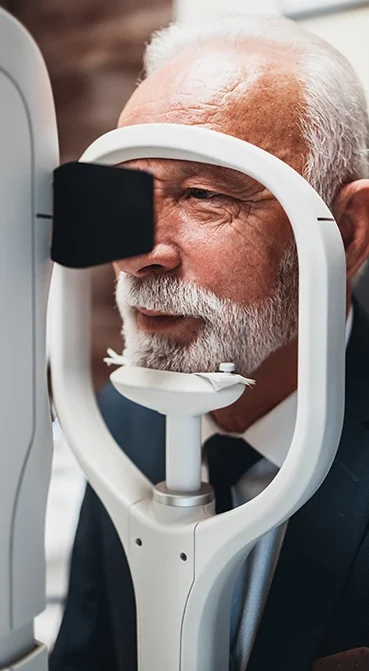
senior man having eyes examined for cataracts

Who Is a Good Candidate for an Advanced Lens?

Many adults with cataracts are good candidates. You may be a strong fit if you:

  • Want to rely less on glasses or readers
  • Have healthy eyes beyond your cataract
  • Are open to small trade-offs, such as some halos at night
  • Have astigmatism or past laser vision correction

Some eyes need a different plan. Multifocal and EDOF lenses are usually not the best fit for patients with glaucoma, macular degeneration, or other eye disease. Your surgeon will help you choose the right lens for your eyes.

Book a Free Consult

happy senior woman hiking with clear vision

What Happens on Procedure Day?

Cataract Surgery is an outpatient procedure, so most patients go home the same day. Here is what a typical day looks like:

1. We numb your eye with drops, and you may receive medicine to help you relax.

2. We remove the cloudy lens using ultrasound energy.

3. Your new lens is placed inside the eye.

4. You rest briefly, then a friend or family member drives you home.

The procedure usually takes less than half an hour. Like any surgery, cataract surgery carries some risks, such as infection or swelling inside the eye. We review each one with you before your procedure.

background image
Eye exam

Why Choose K2 Vision for Cataract Surgery?

Choosing a lens is a big decision, and experience matters. Vision correction is all we do. We have done more procedures than any other practice in the country, and our promise to every patient is that we will use our industry-leading data and our experience to help give you your best vision possible.

The doctors at K2 Vision are among North America’s most experienced surgeons for lens-based vision correction. We are lens agnostic, which means we recommend the lens type that gives you the best result, not a favorite lens or brand. If a better lens comes out that gives patients better results, we will switch to it. We use detailed diagnostics and outcome data from past patients to guide each recommendation.

vision icon

150K+ lens-based procedures performed by our team

vision icon

100+ years of combined experience among our surgeons

vision icon

#1 in the U.S. for the Light Adjustable Lens

vision icon

Thousands of 5-star reviews

What Do Our Patients Say?

"I had simply reached the point in my life where I was SO tired of constantly needing readers, and my distance vision was also starting to become a little questionable... The surgeries on both eyes were seamless and painless, and the entire process was much easier than I ever expected... My first light adjustment is coming up next week, when they will begin fine-tuning my lenses to get my vision exactly where we want it. My goal is 20/20 vision and finally being able to say GOODBYE to my readers!"
Mayumi M., Google review
"K2 Vision was an incredible experience. I had the light-adjustable lenses or lens implanted in one eye. Initially, I was visiting a clinic in Bellevue, but I felt it was crucial to seek a second opinion. I couldn’t be happier with my decision. They were incredibly patient and non-rushed... My vision in my right eye is significantly better than it has been for the past 20 years. I am ecstatic and incredibly happy with my choice of K2 Vision."
Keith B., Google review
"I gave myself the best birthday present this year: clear, vibrant, brighter vision with multifocal IOLs. K2 Vision in Tukwila truly delivered. My distance vision had been fading, my near vision was getting worse, and cataracts were beginning to affect my daily life... The team at K2 Vision was exceptional. Everyone was attentive, caring, and incredibly thorough. They educated me every step of the way... They made this life-changing decision feel easy, safe, and absolutely worth it."
Trinidad J., Google review

Frequently Asked Questions

Standard Cataract Surgery is typically covered by Medicare and most insurance plans. Advanced lenses may involve additional out-of-pocket expenses. We offer flexible financing options, and we review your costs at your consultation.

Yes, many patients with past LASIK, PRK, or RK can still get an advanced lens. Prior surgery changes the shape of the cornea, which can make lens power harder to predict. We will explain which lens types fit best.

Many patients need glasses far less often, and some rarely use them. We will give you a clear picture of what to expect for your eyes.

Some patients notice halos or glare, especially with multifocal lenses. If night driving is a big part of your life, tell us, and we will factor it into your recommendation.

We treat each eye separately and plan the timing for your second eye with you.